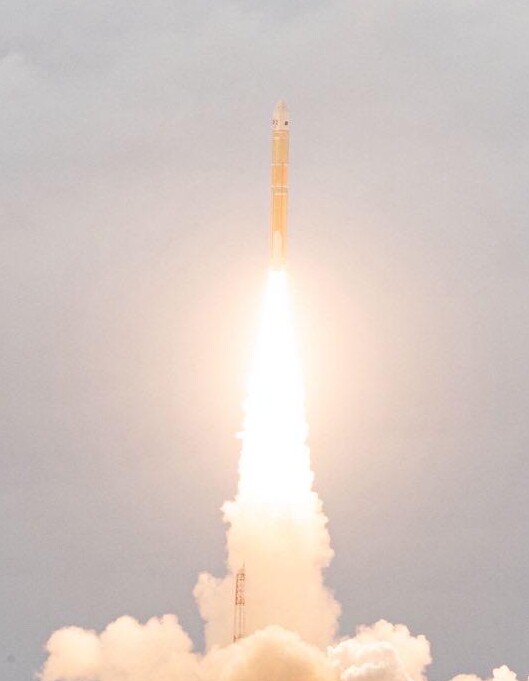
Japan’s ninth H3 mission launched the QZS-7 (Michibiki 7) navigation satellite from Tanegashima Space Center at 19:23 UTC on August 10, or 4:23 a.m. Japan time on August 11. The upper stage deployed the roughly 4.9-ton satellite into its planned high-Earth-orbit transfer trajectory about 29 minutes after liftoff.
Two Missions on One Satellite
QZS-7 expands Japan’s Quasi-Zenith Satellite System, which supplements GPS coverage and positioning performance across Japan and the wider Asia-Oceania region. It also hosts a U.S. Space Force space-domain-awareness sensor designed and built by MIT Lincoln Laboratory.
The hosted payload will provide near-real-time observations of the geosynchronous-orbit belt over the Indo-Pacific to the U.S. Space Surveillance Network. QZS-7 completes a two-payload bilateral program; the first American sensor launched aboard QZS-6 in February 2025.
A Partnership Model in Orbit
Hosting a U.S. sensor on a Japanese navigation satellite avoids launching a separate spacecraft and gives both countries experience integrating hardware, ground systems and sensitive data across national programs. It is also another operational mission for H3, Japan’s replacement for the retired H-IIA. Explore the engineering behind launch vehicles in How Rockets Work.