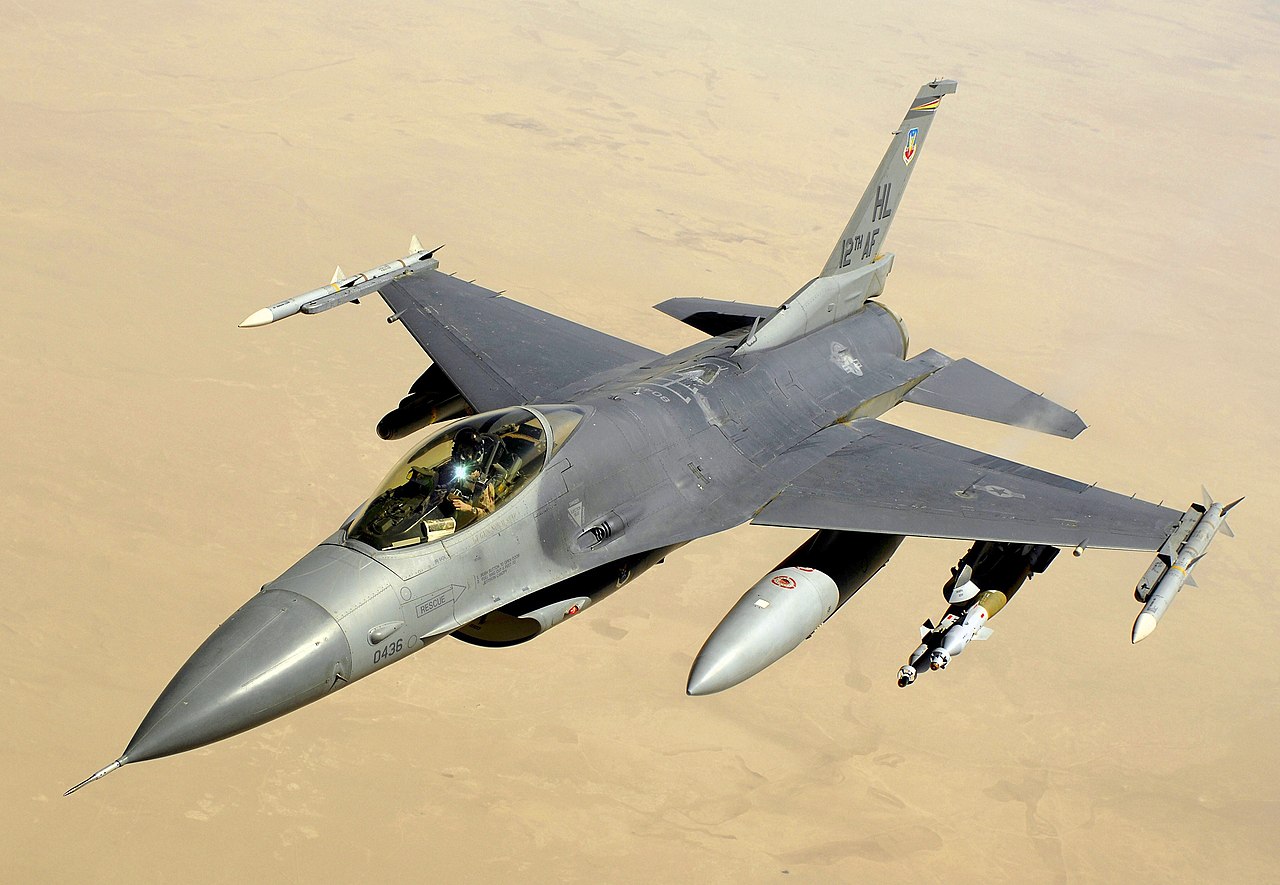
Fly-by-wire is one of those phrases that sounds like jargon but describes a revolution. Before fly-by-wire, pilots moved control surfaces through mechanical cables, hydraulic lines, and pushrods that physically connected the stick to the ailerons, elevators, and rudder. After fly-by-wire, a pilot moves the stick, a computer reads the movement, decides what the aircraft should actually do, and sends commands to electrical actuators that move the surfaces.
Every modern fighter, from the F-16 and F/A-18 to the F-35 and beyond, relies on fly-by-wire. So does every new airliner from the Airbus A320 onward. Understanding how this technology works is the first step to understanding why modern aircraft can do things earlier generations could not even attempt.
The Mechanical World Before Fly-by-Wire
Before the 1970s, fighter pilots flew aircraft that were aerodynamically stable by design. A stable aircraft, nudged off course by turbulence, naturally returns toward level flight. Stability is a virtue in transport aircraft, but it is a liability in fighters because stable aircraft are slow to maneuver. The more stable the airframe, the more force the pilot must apply to change direction.
Engineers learned that if they could build a slightly unstable airframe, they could make it extraordinarily agile. The problem was that an unstable aircraft, left to its own devices, diverges in pitch, roll, or yaw faster than a human pilot can correct. No amount of cable and pushrod could keep such an aircraft flyable.
Fly-by-wire solved that problem. A digital flight control computer sits between the pilot and the control surfaces, making hundreds of corrections per second to keep the unstable airframe flying the direction the pilot wants. The F-16 was the first production fighter built around this idea, and it changed everything.
How the System Actually Works
At the heart of every fly-by-wire system is a flight control computer, usually triplicated or quadruplicated for redundancy. The pilot’s stick and rudder pedals have position sensors rather than direct mechanical linkages. When the pilot moves the stick, the sensors send electrical signals to the computer.
The computer compares the pilot’s command to what the aircraft is actually doing. It reads data from the inertial measurement unit, air data computer, angle-of-attack sensors, and in modern aircraft a range of other inputs. It calculates what control surface deflections are required to produce the motion the pilot asked for, limited by the flight envelope the engineers built into the software.
The computer then sends commands to electrically controlled hydraulic actuators on each control surface. The actuators move the ailerons, elevators, rudders, flaperons, or vectored nozzles by the precise amount required. All of this happens dozens of times per second, invisibly, with the pilot simply feeling the airplane respond cleanly to stick input.
The Flight Envelope Protection Advantage
One of the biggest benefits of fly-by-wire is flight envelope protection. The software knows the aircraft’s limits and refuses to let the pilot exceed them, or at least warns before exceeding them. In an Airbus airliner, pulling full back on the sidestick commands the maximum angle of attack the wing can sustain without stalling, and the computer will not let the aircraft stall no matter how hard the pilot pulls.
In fighters, envelope protection is usually softer, because combat sometimes requires operating at the edge. But the software still prevents things like rolling at speeds that would rip the tail off, exceeding structural G limits, or departing controlled flight in ways that would end with a smoking hole in the ground. This is why modern fighters can fly at angles of attack that would have been fatal in a mechanically controlled aircraft.
Envelope protection also enables features like carefree handling. A pilot can throw full stick deflections in any direction, at any speed, and trust that the aircraft will do the maneuver requested without departing controlled flight. In a dogfight, that carefree handling is the difference between a kill and a crash.
Redundancy and Failure Modes
Trusting your life to a computer only makes sense if the computer cannot fail. Fly-by-wire systems are designed with extraordinary redundancy. Most fighters have three or four independent flight control computers, each running different software written by different teams to avoid common-mode bugs. The computers vote on every command, and any computer that disagrees with the majority is isolated.
Power is equally redundant. Multiple generators, multiple battery backups, and in some aircraft a ram air turbine that deploys if all else fails keep the electrical bus alive. Hydraulic power to the actuators is also duplicated, with separate hydraulic systems driven by different engines.
Backup mechanical controls are rare in modern designs. The F-16 has no mechanical reversion. The F-22 has none. The F-35 has none. The reasoning is that a true loss of fly-by-wire is less likely than a wing falling off, and adding mechanical backups would add weight without materially improving safety.
Fly-by-Wire Enables Stealth and Agility Together
Stealth and agility used to be in tension. A low-observable airframe demands compromises in aerodynamics, because flat panels and internal weapons bays disrupt clean airflow. Without fly-by-wire, a stealth fighter would be a flying brick. With fly-by-wire, the computer compensates for aerodynamic oddities in real time, letting engineers shape the aircraft for radar cross-section first and aerodynamics second.
The stealth coatings and shaping of aircraft like the F-22 and F-35 would be unflyable without advanced flight control software. The thrust vectoring of the F-22 and Su-57 is orchestrated entirely by the flight control computer, blending vectored thrust with aerodynamic controls to keep the aircraft flying at angles of attack well above 60 degrees.
This is why modern aircraft can be simultaneously stealthy and maneuverable, while earlier generations had to choose one or the other. The computer makes the compromise invisible.
The Future: Artificial Intelligence in the Loop
The next evolution of fly-by-wire is already here. The Air Force Research Laboratory has flown F-16 variants under full artificial intelligence control in dogfight scenarios, with the pilot serving as a safety monitor. Sixth-generation fighters will likely feature AI copilots that handle routine flying while the human focuses on tactics and decision-making.
Loyal wingman drones will use the same fly-by-wire foundations to fly formation with manned aircraft, respond to voice or gesture commands, and execute complex maneuvers autonomously. The line between pilot input and computer judgment will continue to blur until the two are essentially indistinguishable.
None of this would be possible without the fundamental breakthrough of letting a computer sit between the pilot and the controls. Fly-by-wire did not just change how airplanes fly. It changed what airplanes can be.
Key Takeaways
- Fly-by-wire replaces mechanical control linkages with electrical signals and digital flight computers.
- The technology enables inherently unstable airframes that deliver unprecedented agility.
- Redundant computers, sensors, and power supplies make the system safer than mechanical alternatives.
- Envelope protection prevents pilots from overstressing or departing controlled flight.
- Modern stealth and thrust vectoring are only possible because of fly-by-wire software.