Facts summary and sources
Rockwell B-1 Lancer: Published high-altitude maximum: Mach 1.25 (Published specification). B-1B high-altitude figure from the Air Force Test Center; USAF separately lists Mach 1.2 at sea level. First flight: 1974. 1974 refers to the B-1A prototype; the B-1B first flew on 18 October 1984.
This is a secondary compilation. A source-check date applies only to the listed claim, not to the whole page or its translation. A page update is not a source check.
Sources and check records
- Air Force Test Center: B-1 development history — B-1A high-altitude speed is Mach 2.2; the redesigned B-1B is listed at Mach 1.25 at high altitude. [The high-altitude figure is separate. AFTC lists Mach 0.96 at low altitude, while the USAF fact sheet lists Mach 1.2 at sea level; the sources use different low-altitude figures and are not treated as equivalent.] · Source checked for this claim: 2026-10-19
- U.S. Air Force: B-1B Lancer fact sheet — B-1B: four F101-GE-102 engines, four crew, 75,000 lb payload and 477,000 lb maximum takeoff weight. Ceiling is more than 30,000 ft and range is described as intercontinental. [September 2016 specification. Convert 477,000 lb to about 216,364 kg; the printed metric value is inconsistent. Do not treat lower bounds or unlabelled weight as exact ceiling or empty weight.] · Source checked for this claim: 2026-10-19
- Boeing historical products: B-1 Lancer — B-1A first flew on 23 December 1974; B-1B first flew on 18 October 1984 and reached initial operational capability on 1 October 1986. Four B-1As and 100 B-1Bs were built. [Historical programme milestones. Boeing lists 60,000 ft operating altitude and a range greater than 7,000 miles; neither is entered as an exact service ceiling or range.] · Source checked for this claim: 2026-10-19
- Air Force Global Strike Command: LRASM validation at Dyess — The 7th Bomb Wing conducted a B-1B LRASM pre-flight procedure validation on 2 June 2026. [Official report published 7 July 2026 confirms continuing B-1B activity; it is not a retirement schedule or a new missile operational declaration.] · Event date: 2026-06-02 · Source checked for this claim: 2026-10-19
- Wikipedia reference · Source-check date not recorded
✈️ Full Specifications
Reference: B-1B. Mach 1.25 is a published high-altitude figure; USAF separately gives Mach 1.2 at sea level and 900-plus mph, not a fixed Mach-to-km/h conversion. AFTC instead lists low-altitude Mach 0.96; the two official low-altitude descriptions differ and are not presented as equivalent. USAF ceiling is only >30,000 ft (>9,144 m); Boeing’s 60,000 ft (18,288 m) is labelled operating altitude. Range is described as intercontinental, or >7,000 miles in Boeing history. Exact ceiling and range remain blank. Dimensions are converted from USAF feet; maximum takeoff weight is 477,000 lb (about 216,364 kg). Production is 100 B-1Bs, excluding four B-1As. No comparable price-year basis is supplied for unit cost.
| Designation | B-1B (specification reference) |
| Manufacturer | Rockwell International (now Boeing) |
| Country | 🇺🇸 United States |
| First flight | 1974 |
| First-flight context | 1974 refers to the B-1A prototype; the B-1B first flew on 18 October 1984. |
| Service Entry | 1986 |
| Crew | 4 |
| Length | 44.5 m (146 ft) |
| Wingspan | 41.76 m (137 ft) |
| Height | 10.36 m (34 ft) |
| Max Takeoff Weight | 216,364 kg (477,083 lb) |
| Max Speed (Mach) | 1.25 |
| Published high-altitude maximum | Mach 1.25 — B-1B high-altitude figure from the Air Force Test Center; USAF separately lists Mach 1.2 at sea level. |
| Speed evidence basis | Published specification |
| Engine | 4 × General Electric F101-GE-102 afterburning turbofans |
| Production | 100 |
🌐 Operators
🔁 Variants
- B-1A — four development aircraft
- B-1B — 100 production bombers
⚔️ Armament
Overview
The B-1B Lancer is a four-engine, variable-sweep-wing bomber used by the U.S. Air Force for conventional strike missions. Its nickname, “Bone,” comes from saying B-One.
B-1A and B-1B
The B-1A first flew in 1974. The revised B-1B flew in 1984 and reached initial operational capability in October 1986. The redesign traded some high-altitude speed for changes to the airframe, inlets and mission systems. The Air Force Test Center lists Mach 2.2 for the B-1A and Mach 1.25 at high altitude for the B-1B.
Payload and service
The B-1B can carry 75,000 lb of weapons. The USAF lists alternative loads including 24 JASSM missiles, 24 GBU-31 bombs or 84 Mk-82 bombs. These capacities are separate loadouts. Its nuclear mission ended in 1994, and the treaty-related conventional-only conversion finished in 2011.
Official reporting on a June 2026 LRASM procedure check at Dyess confirms that the B-1B remains in use. That test does not establish a fleet retirement date or a new operational missile capability.
Video
Frequently Asked Questions
How fast is the B-1B?
The Air Force Test Center lists Mach 1.25 at high altitude. AFTC also lists low-altitude Mach 0.96, whereas the USAF fact sheet lists Mach 1.2 at sea level; these official descriptions differ. Neither should be replaced by the B-1A’s Mach 2.2 figure.
How many B-1s were built?
Four B-1A development aircraft and 100 B-1B production bombers were built. The production figure in the specifications counts B-1Bs only.
Does the B-1B still carry nuclear weapons?
The USAF ended its nuclear mission in 1994. Physical conversion to conventional-only configuration was completed in March 2011.
Is the B-1B still in service?
Yes. Official reporting documents B-1B LRASM procedure validation at Dyess in June 2026. This page does not infer a retirement date from B-21 plans.
Primary Sources
- Air Force Test Center: B-1 development history
- U.S. Air Force: B-1B Lancer fact sheet
- Boeing historical products: B-1 Lancer
- Air Force Global Strike Command: LRASM validation at Dyess
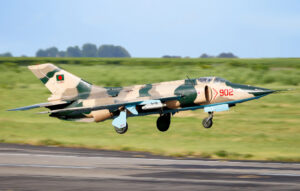 Nanchang Q-5 Fantan
 Sukhoi Su-17 Fitter (variable sweep)
 BAC TSR-2
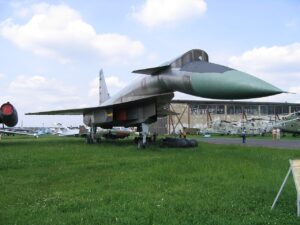 Sukhoi T-4 Sotka
 Xian JH-7 Flying Leopard
 Mikoyan MiG-27 Flogger-D