Facts summary and sources
Boeing F-15EX Eagle II: speed Mach 2.5 (Published specification). First flight: 2021.
This is a secondary compilation. A source-check date applies only to the listed claim, not to the whole page or its translation. A page update is not a source check.
Sources and check records
- U.S. Air Force: First F-15EX acceptance — The Air Force accepted its first F-15EX on March 10, 2021 for the test program; its two-seat airframe can be operated by one pilot. [Acceptance for testing is not initial operational capability.] · Event date: 2021-03-10 · Source checked for this claim: 2026-10-07
- GAO: Weapon Systems Annual Assessment 2025 — The F-15EX achieved initial operational capability in July 2024. [Operational-readiness milestone, separate from the 2021 first test delivery.] · Source checked for this claim: 2026-10-07
- Boeing: F-15EX Eagle II — Boeing publishes Mach 2.5 for the F-15EX. [Manufacturer specification for the EX variant.] · Source checked for this claim: 2026-10-07
✈️ Full Specifications
| Designation | F-15EX Eagle II |
| Manufacturer | Boeing |
| Country | 🇺🇸 United States |
| First flight | 2021 |
| Service Entry | 2024 |
| Crew | 2 |
| Length | 19.43 m (63.7 ft) |
| Wingspan | 13.05 m (42.8 ft) |
| Height | 5.63 m (18.5 ft) |
| Max Takeoff Weight | 36,741 kg (81,014 lb) |
| Max Speed (Mach) | 2.5 |
| Speed evidence basis | Published specification |
| Service Ceiling | 15,240 m (50,002 ft) |
| Climb Rate | 254 m/s (50000 ft/min) |
| Engine | 2 × GE F110-GE-129 |
| Thrust (each) | Dry 77.6 kN · AB 129.6 kN |
🌐 Operators
🔁 Variants
- F-15EX — Standard USAF variant
- F-15IA — Israeli derivative, in development
- F-15EX (Indonesia) — Export variant, 24 ordered
⚔️ Armament
Overview
The Boeing F-15EX Eagle II is a new-build member of the F-15 family intended to replace older F-15C/D aircraft. It has two seats, although the U.S. Air Force says it can be operated by one pilot. Its equipment and weights differ from the legacy F-15C, so the two variants should not share a combined specification table.
Design & Development
The Eagle II combines the proven F-15 airframe with the digital fly-by-wire flight control system from the F-15SA (Saudi Arabia variant), the AN/APG-82(V)1 AESA radar from the F-15E Strike Eagle, and the new Eagle Passive/Active Warning and Survivability System (EPAWSS) — a comprehensive electronic-warfare suite that gives the F-15EX a sensor and self-protection capability comparable in some respects to fifth-generation jets.
Boeing lists carriage of up to 12 AMRAAM air-to-air missiles for the F-15EX. Its external stations can accommodate large payloads, but a proposed weapon, an available station and a weapon cleared for operational use are different claims. This profile does not treat proposed hypersonic carriage as an operational certification.
Operational History
The first F-15EX was accepted for testing on March 10, 2021. GAO records initial operational capability in July 2024. Those are separate milestones: a test delivery is not the same as operational readiness. Procurement targets and delivered fleet totals change over time, so undated figures are not presented as a current inventory. GAO 2025 program assessment.
Capabilities
The F-15EX has the longest legs of any U.S. tactical fighter currently in production, the highest payload, and one of the most powerful AESA radars. Where it gives ground to the F-22 and F-35 is in radar cross-section: the Eagle II is not a stealth aircraft. The doctrine that has emerged is to use the F-15EX as a “weapons truck” operating behind stealth penetrators, supplying long-range missiles and standoff weapons that the smaller fifth-gen jets cannot carry.
References
- Boeing F-15EX program documentation, 2020–2024
- U.S. Air Force F-15EX Initial Operational Test & Evaluation reports
- Air & Space Forces Magazine, “F-15EX in the Force Mix,” 2024
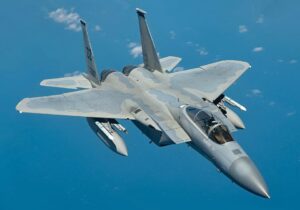 McDonnell Douglas F-15 Eagle
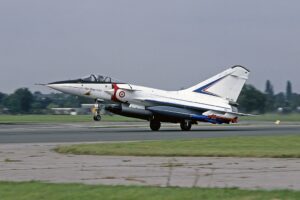 Dassault Mirage 4000
 Lockheed F-104 Starfighter
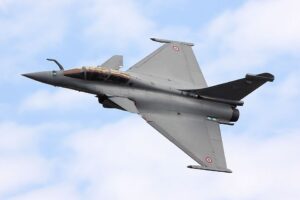 Dassault Rafale