Checked September 8, 2026. X-59 is already flying. Its first flight was October 28, 2025; first supersonic flight was June 5, 2026. NASA’s September 4 report records 25 flights and says acoustic validation is the next major research phase.
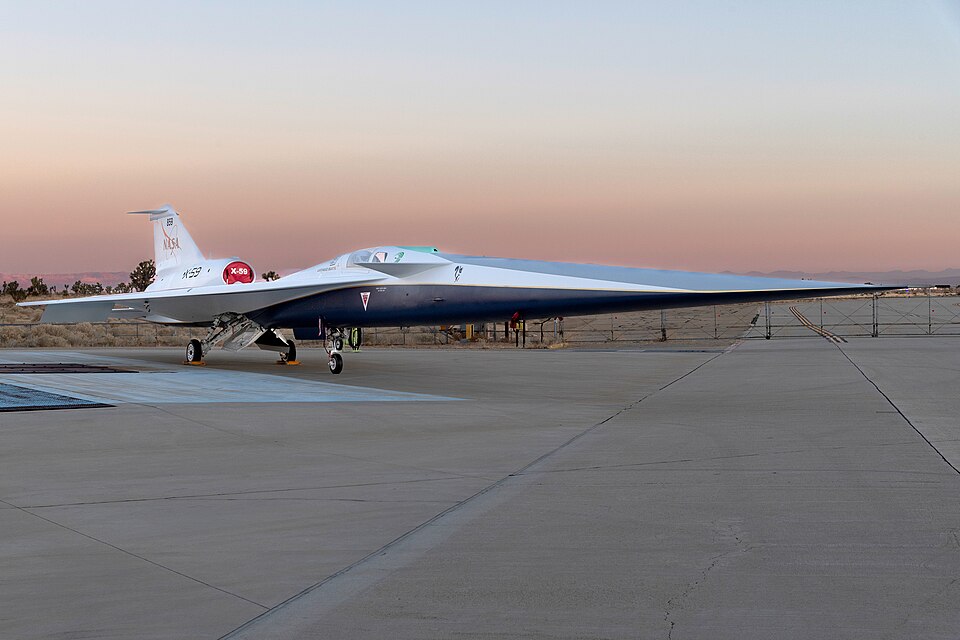
For over 50 years, a single rule has kept supersonic passenger flight grounded over land: the sonic boom ban. The thunderous shockwave produced by aircraft exceeding Mach 1 led the FAA to prohibit overland supersonic flight in 1973 — effectively killing the dream of fast coast-to-coast travel. Now, NASA’s X-59 Quesst is designed to change that forever.
What Is the X-59?
The X-59 QueSST (Quiet SuperSonic Technology) is an experimental aircraft built by Lockheed Martin Skunk Works under NASA’s Low-Boom Flight Demonstrator program. Its mission is simple but revolutionary: prove that a supersonic aircraft can be designed to produce a “sonic thump” instead of a sonic boom — a sound no louder than a car door closing.
The aircraft features an unusual elongated nose that makes up nearly a third of its total 99.7-foot length. This needle-like shape is not just for aesthetics — it’s engineered to prevent shockwaves from coalescing into a single loud boom as they reach the ground.
Key Specifications
- Cruise speed: Mach 1.4 (~925 mph / 1,488 km/h)
- Altitude: 55,000 feet (16,764 m)
- Length: 99.7 feet (30.4 m)
- Engine: Single General Electric F414-GE-100 (same engine family used in the F/A-18 Super Hornet)
- Noise design target, not a measured result: Approximately 75 PLdB (perceived level in decibels) — compared to 105+ PLdB for Concorde
The Community Overflight Campaign
NASA’s plan goes beyond just building the aircraft. The community overflight campaign, planned after flight-envelope expansion and acoustic validation, will see the X-59 fly over several U.S. cities while researchers on the ground measure public response to the reduced sonic signature.
The data collected will be submitted to the FAA and ICAO (International Civil Aviation Organization) to support new regulations that could replace the blanket ban on overland supersonic flight with a noise-based standard. If successful, this could open the door for a new generation of supersonic airliners.
Why It Matters
The X-59 is not a passenger aircraft — it’s a technology demonstrator meant to prove a concept. But the implications are enormous. Companies like Boom Supersonic are already developing commercial supersonic jets (the Overture), and a change in regulations could unlock routes that were previously impossible. Boom’s own XB-1 demonstrator broke the sound barrier in January 2025, a parallel breakthrough to the X-59’s quiet boom ambitions.
Imagine flying from New York to Los Angeles in 2.5 hours instead of 5.5 — without shaking windows along the way. That’s the future the X-59 is trying to build. It’s also the answer to the economic and regulatory problems that retired the Concorde two decades ago.
Challenges Ahead
The aircraft has progressed from ground testing to supersonic flight. NASA confirmed Mach 1.4 at about 55,000 feet on June 12, 2026. The remaining work includes measuring its acoustic signature with ground and airborne instruments, then studying community responses.
These research results can inform future noise standards. They do not themselves certify a passenger aircraft or establish a date when commercial routes will open.