Facts summary and sources
Lockheed F-104 Starfighter: Published F-104C maximum speed: 1,320 mph (about 2,124 km/h) (Published specification). The primary C-variant museum record gives mph, not an exact maximum Mach number. First flight: 1954. 1954, XF-104 prototype family; not the C variant’s first-flight date.
This is a secondary compilation. A source-check date applies only to the listed claim, not to the whole page or its translation. A page update is not a source check.
Sources and check records
- National Museum of the USAF: F-104C Starfighter — F-104C: maximum speed 1,320 mph; range 1,250 miles; ceiling 58,000 ft; one crew member and one J79 engine with 15,800 lbf afterburning thrust. [All numeric specifications on this page use the F-104C reference. Convert published mph to about 2,124 km/h; do not infer an exact maximum Mach number or apply F-104G figures.] · Source checked for this claim: 2026-10-19
- National Museum of the USAF: F-104 development and armament — The XF-104 first flew in 1954. The F-104C carried an M61 20 mm cannon, two air-to-air missiles and nuclear or conventional bombs. [The first-flight year refers to the prototype family, not first flight of the C variant. Weapon options are not simultaneous full-load claims.] · Source checked for this claim: 2026-10-19
- Lockheed Martin: Starfighter design and international production — Lockheed describes the F-104 as a Mach 2 fighter with thin wings that was licensed and operated internationally in several roles. [Manufacturer history supports the general design and export roles, but does not provide a precise C-variant Mach maximum or a total of 2,578.] · Source checked for this claim: 2026-10-19
- NASA: F-104 research and support operations — NASA Armstrong operated eleven F-104s, with the last mission by tail number 826 on 31 January 1994. [NASA research-service history must be distinguished from military combat service and later private operation.] · Event date: 1994-01-31 · Source checked for this claim: 2026-10-19
- Republic of China Air Force: F-104 service exhibition — The Air Force exhibition traces Taiwanese F-104 service from 1960 to F-104G decommissioning on 22 May 1998. [Retirement date applies to Taiwan, not to every operator. Japan and Taiwan must not be described as NATO members.] · Event date: 1998-05-22 · Source checked for this claim: 2026-10-19
- Wikipedia reference · Source-check date not recorded
✈️ Full Specifications
Reference variant: F-104C, not F-104G. Museum figures: maximum speed 1,320 mph (about 2,124 km/h), range 1,250 miles (about 2,012 km, mission profile unspecified), ceiling 58,000 ft (about 17,678 m). Dimensions and 15,800 lbf afterburning thrust are converted from imperial units. The museum’s 27,853 lb maximum weight is not explicitly maximum takeoff weight. Exact maximum Mach, empty weight, comparable unit cost and a verified family production total are not supplied by these C-variant records.
| Designation | F-104C (specification reference) |
| Manufacturer | Lockheed |
| Country | 🇺🇸 United States |
| First flight | 1954 |
| First-flight context | 1954, XF-104 prototype family; not the C variant’s first-flight date. |
| Crew | 1 |
| Length | 16.71 m (54.8 ft) |
| Wingspan | 6.68 m (21.9 ft) |
| Height | 4.11 m (13.5 ft) |
| Published F-104C maximum speed | 1,320 mph (about 2,124 km/h) — The primary C-variant museum record gives mph, not an exact maximum Mach number. |
| Speed evidence basis | Published specification |
| Max Speed | 2,124 km/h |
| Service Ceiling | 17,678 m (58,002 ft) |
| Range | 2,012 km (1,249 mi) |
| Engine | 1 × General Electric J79 afterburning turbojet |
| Thrust (each) | AB 70.3 kN |
🌐 Operators
🔁 Variants
- F-104A — interceptor
- F-104C — tactical fighter, specification reference
- F-104G — export multirole version
- Two-seat and reconnaissance versions also existed
⚔️ Armament
Overview
The Lockheed F-104 Starfighter was a single-engine fighter with a narrow fuselage and small, thin wings. Developed under Kelly Johnson, it became a Mach 2 aircraft used for interception, tactical strike and reconnaissance.
Which Starfighter do these specifications describe?
This page uses the F-104C held by the National Museum of the USAF as its specification reference. The museum lists 1,320 mph maximum speed, about 2,124 km/h. This avoids combining the C model’s museum data with the export F-104G’s engine or performance figures.
The C model had one pilot, a J79 engine, an M61 cannon and provisions for air-to-air missiles and bombs. Small wings suited high-speed flight but also imposed demanding low-speed handling and landing requirements.
International and research service
F-104s were built and operated in several countries. NATO air forces were major users; Japan and Taiwan also operated the type. Taiwan retired its F-104G fleet in May 1998. NASA used eleven Starfighters at its California flight-research centre, completing the last of those missions in January 1994. Military retirement and research or private flying are different service histories.
Video
Frequently Asked Questions
How fast was the F-104C?
The National Museum of the USAF gives 1,320 mph, about 2,124 km/h. It does not provide an exact maximum Mach number for that C-variant specification.
Are F-104C and F-104G specifications interchangeable?
No. The C and G had different equipment and roles. This page consistently uses the F-104C museum record for numeric specifications.
When did the F-104 first fly?
The XF-104 prototype flew in 1954. That is the family’s first-flight year, not the first-flight date of every later variant.
Did retirement end every F-104 flight?
No. Military service, NASA research missions and private flying have different timelines. NASA’s Armstrong fleet completed its last F-104 mission in January 1994; Taiwan retired its military F-104G in May 1998.
Primary Sources
- National Museum of the USAF: F-104C Starfighter
- Lockheed Martin: Starfighter design and international production
- NASA: F-104 research and support operations
- Republic of China Air Force: F-104 service exhibition
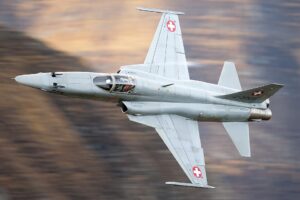 Northrop F-5 Tiger II
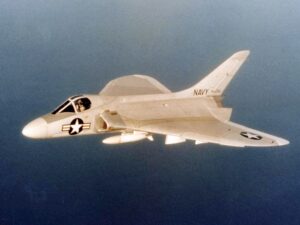 Douglas F4D Skyray
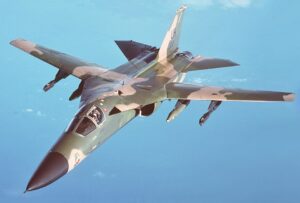 General Dynamics F-111 Aardvark
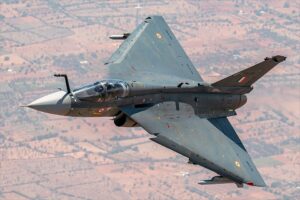 HAL Tejas
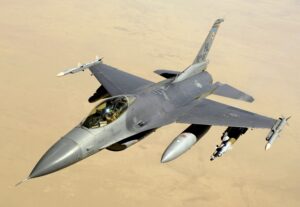 General Dynamics F-16 Fighting Falcon
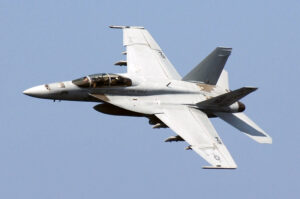 Boeing F/A-18E/F Super Hornet