Stealth aircraft use shape, materials and signature management to reduce detectability. Their radar return is not a fixed marble, golf ball or truck-sized property: measurement conditions must accompany any numerical comparison.
What Is Radar Cross-Section (RCS)?
Radar works by sending out radio waves that bounce off objects and return to the receiver. The strength of that return signal depends on the object’s Radar Cross-Section (RCS) — not its physical size, but how effectively it reflects radar energy back to the source.
RCS is expressed as an area, but comparison requires matching radar frequency, viewing angle, polarisation and aircraft configuration. This article does not have public test data supporting precise, like-for-like RCS numbers for the aircraft examples.
Four Design Features to Understand
1. Shape (Planform Alignment)
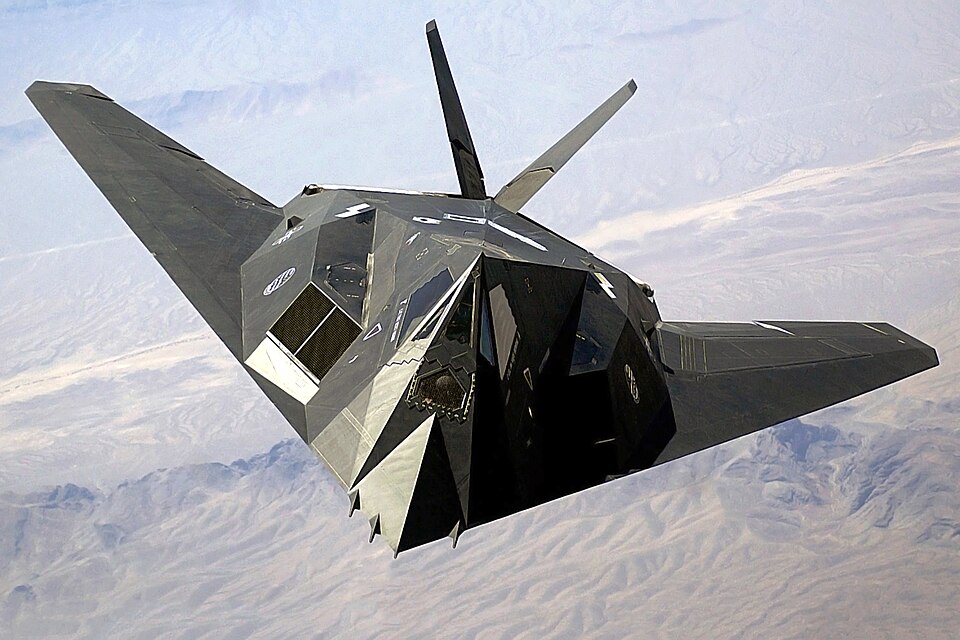
Aircraft shaping manages how energy scatters, including the effects of edges, cavities and intakes. Faceted surfaces are one solution; curved low-observable shapes are also possible.
This is why stealth aircraft look so distinctive — the F-117 Nighthawk‘s faceted diamond shape, the B-2’s flying wing, the F-22’s angled surfaces — they’re all optimized to deflect radar.
2. Radar-Absorbing Materials (RAM)
Radar-absorbing materials dissipate part of the incident energy and complement shaping. They work within design limits rather than absorbing every frequency equally. Surface condition and maintenance also matter.
3. Internal Weapons Carriage
External weapons — bombs, missiles, fuel tanks — create massive radar returns. Stealth aircraft carry weapons in internal bays, keeping the outer surface smooth and radar-reflective surfaces hidden. The F-22 carries six AIM-120 AMRAAMs and two AIM-9X Sidewinders internally.
4. Engine/Intake Design
Jet engine fan blades are excellent radar reflectors. Stealth aircraft use serpentine (S-shaped) intakes that hide the engine face from incoming radar. The intake ducts curve so that radar waves entering the intake bounce off the walls and get absorbed before reaching the reflective engine.
Beyond Radar: Other Signatures
True stealth requires managing multiple signatures:
- Infrared (heat): Flat, wide exhaust nozzles spread and cool the exhaust plume. The B-2’s engines are buried deep in the wing to shield their heat from below.
- Visual: Reduced contrails, camouflage paint schemes, smaller overall size
- Electronic emissions: Low-probability-of-intercept (LPI) radar that’s hard to detect. Passive sensors that listen without broadcasting.
- Acoustic: Less relevant for high-altitude operations but considered in design
Can Stealth Be Defeated?
No technology is invincible. Potential counters include:
- Low-frequency radar: changing frequency can change scattering and detection performance; whether the resulting data support a reliable track or engagement depends on the full system.
- Bistatic/multistatic radar: Separate the transmitter and receiver so reflected energy doesn’t need to return to the source
- Infrared Search and Track (IRST): Passive heat sensors that don’t rely on radar at all
- Networking: Sharing data from many sensors to build a composite picture
The cat-and-mouse game between stealth and detection continues to drive innovation on both sides.
Dive deeper with our How Stealth Technology Works page, or explore stealth aircraft in our collection.
Sources and Limits
The conditions behind a radar-signature measurement are explained in this research report hosted by NASA. MIT Lincoln Laboratory’s radar course covers RCS, detection and tracking. The USAF museum’s Tacit Blue history documents curved low-observable design.
This update replaces unattributed RCS figures and animal-size analogies with measurement limits. Detecting a return, identifying an aircraft and generating weapons-quality guidance are different tasks.