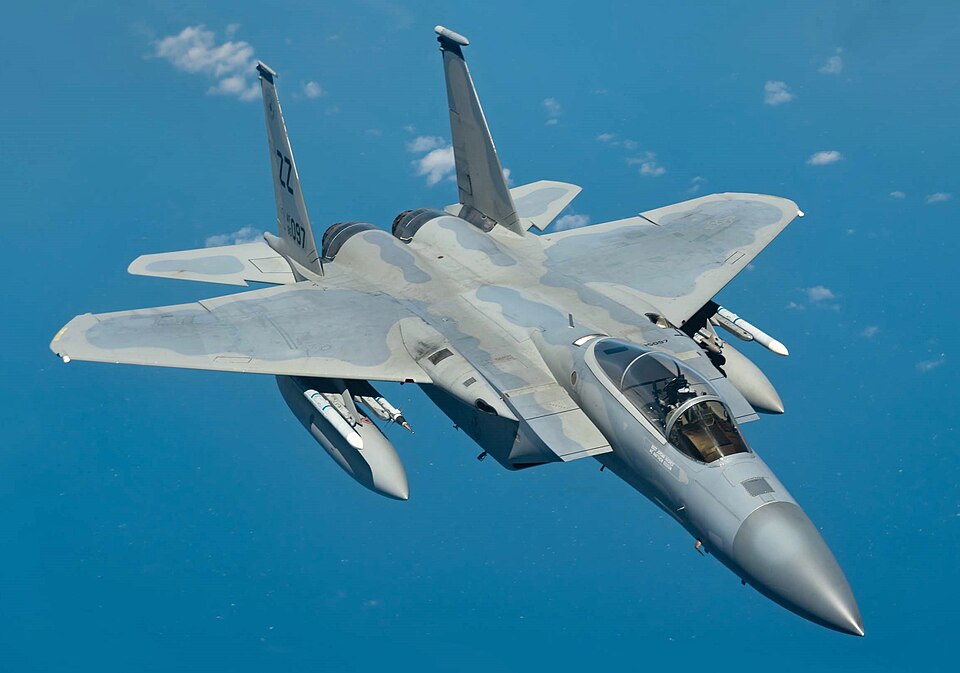
Every supersonic aircraft — from the Bell X-1 to the F-35 Lightning II — relies on one fundamental principle: Newton’s Third Law. For every action, there is an equal and opposite reaction. A jet engine accelerates gas backward; the aircraft moves forward. Simple in concept, extraordinarily complex in execution.
The Four Types of Jet Engine
1. Turbojet
The original jet engine. Air enters the intake, gets compressed by spinning blades, mixed with fuel and ignited in the combustion chamber, then blasted out the back through a turbine (which drives the compressor) and the exhaust nozzle.
Pros: Simple, excellent at high speeds
Cons: Very fuel-hungry, extremely loud
Used on: Early fighters (MiG-21, F-104), Concorde (Olympus 593)
2. Turbofan
The modern standard. A turbofan adds a large fan in front that moves a huge volume of air around the core engine (the “bypass” air). This bypass air provides most of the thrust while being much quieter and more fuel-efficient.
Low-bypass turbofans (bypass ratio ~0.3–1.0) power military fighters — they’re a compromise between efficiency and high-speed performance. Examples: Pratt & Whitney F119 (F-22), General Electric F414 (Super Hornet).
High-bypass turbofans (bypass ratio 5–12+) power airliners — maximum fuel efficiency at subsonic speeds. Examples: CFM LEAP (737 MAX), Rolls-Royce Trent (787).
3. Ramjet
At high speeds, incoming air is compressed by the aircraft’s own velocity — no spinning compressor needed. A ramjet has no moving parts: air rams in, fuel is added, combustion occurs, exhaust shoots out.
Catch: Ramjets don’t work from a standstill — they need to be accelerated to around Mach 2+ before they can function. This is why ramjet-powered missiles are launched from aircraft or boosted by rockets first.
Used on: SR-71 Blackbird (J58 — technically a turboramjet hybrid), BrahMos missile
4. Scramjet (Supersonic Combustion Ramjet)
The frontier of air-breathing propulsion. In a regular ramjet, incoming air is slowed to subsonic speed before combustion. In a scramjet, the air flows through the engine at supersonic speed the entire time.
This is incredibly difficult — it’s been compared to “lighting a match in a hurricane.” But scramjets can theoretically operate at Mach 5 to Mach 15+, far beyond what any other air-breathing engine can achieve.
Used on: NASA X-43A (Mach 9.68 — fastest air-breathing vehicle ever), Boeing X-51 Waverider (Mach 5.1)
Afterburners: Raw Power
An afterburner injects additional fuel directly into the exhaust stream after the turbine. The fuel ignites in the hot exhaust gases, producing a dramatic thrust increase (40-70%) at the cost of massive fuel consumption. The iconic blue-orange flame cone behind a fighter in full afterburner is this extra combustion in action.
What’s Next?
The future of jet propulsion includes:
- Adaptive cycle engines: The GE XA100 and P&W XA101 can change their bypass ratio in flight — efficient like a turbofan at cruise, powerful like a turbojet at sprint
- Rotating detonation engines: Use continuous detonation waves instead of steady combustion for dramatically higher efficiency
- Combined cycle engines: Turbojet + ramjet + scramjet in one package, operating from standstill to Mach 5+ (like the proposed SABRE engine for Reaction Engines’ Skylon spaceplane)
Explore engine types in our Supersonic Engine Encyclopedia.
References
- Fry, R.S. (2004). A Century of Ramjet Propulsion Technology Evolution. Journal of Propulsion and Power, 20(1), 27-58. DOI: 10.2514/1.9178
- Curran, E.T. (2001). Scramjet Engines: The First Forty Years. Journal of Propulsion and Power, 17(6), 1138-1148. DOI: 10.2514/2.5875
- Mattingly, J.D. (2006). Elements of Propulsion: Gas Turbines and Rockets. AIAA Education Series. DOI: 10.2514/4.861789