Facts summary and sources
Mitsubishi T-2: speed Mach 1.6 (source basis for this value has not been checked). First flight: 1971.
This is a secondary compilation. A source-check date applies only to the listed claim, not to the whole page or its translation. A page update is not a source check.
No claim-by-claim source checks are recorded yet.
✈️ Full Specifications
| Designation | T-2 / T-2A / T-2B |
| Manufacturer | Mitsubishi Heavy Industries |
| Country | 🇯🇵 Japan |
| First flight | 1971 |
| Service Entry | 1975 |
| Retired | 2006 |
| Crew | 2 |
| Length | 17.86 m (58.6 ft) |
| Wingspan | 7.88 m (25.9 ft) |
| Height | 4.39 m (14.4 ft) |
| Empty Weight | 6,360 kg (14,024 lb) |
| Max Takeoff Weight | 12,800 kg (28,224 lb) |
| Max Speed (Mach) | 1.6 |
| Speed evidence basis | Published specification |
| Max Speed | 1,700 km/h (1,056 mph) |
| Service Ceiling | 15,240 m (50,002 ft) |
| Range | 2,870 km (1,782 mi) |
| Climb Rate | 178 m/s (35039 ft/min) |
| Engine | 2 × Ishikawajima-Harima (IHI) TF40-IHI-801A (Adour Mk 801A licence-built) |
| Thrust (each) | Dry 22.6 kN · AB 32.5 kN |
| Production | 90 |
🌐 Operators
🔁 Variants
- T-2A — Early trainer variant (28 built)
- T-2B — Advanced trainer with full weapons capability (62 built)
- F-1 — Derived single-seat strike fighter (77 built)
⚔️ Armament
Overview
The Mitsubishi T-2 was Japan’s first indigenous supersonic aircraft and the first jet-powered Japanese aircraft of any kind to enter production since the end of World War II. Designed in the late 1960s as an advanced trainer for the Japan Air Self-Defense Force (JASDF), the T-2 served from 1975 until 2006 and provided the basis for the Mitsubishi F-1 strike fighter — Japan’s first post-war indigenous combat aircraft.
Design & Development
The T-2 program began in 1967 as a JASDF requirement to replace the ageing F-86 Sabre and T-33 Shooting Star fleets used for advanced training. Mitsubishi was the prime contractor, with Fuji and Kawasaki as subcontractors. The design borrowed elements from the SEPECAT Jaguar — both aircraft had a similar configuration with shoulder-mounted wings, twin engines side-by-side in the fuselage, and modest dimensions — though the T-2 was an independent design rather than a licensed Jaguar derivative.
Two Rolls-Royce/Turbomeca Adour Mk 801A turbofan engines (licence-built by Ishikawajima-Harima Heavy Industries as the TF40-IHI-801A) powered the aircraft. The first prototype flew on July 20, 1971, with Mitsubishi test pilot Kazumi Ono at the controls. The T-2 exceeded Mach 1 on its 10th flight, becoming the first Japanese-designed aircraft to break the sound barrier.
Operational History
Ninety T-2 aircraft were built between 1975 and 1988: 28 T-2A early trainers and 62 T-2B advanced trainers. The aircraft served at the JASDF’s 4th Air Wing at Matsushima Air Base and was the mount of the JASDF’s “Blue Impulse” aerobatic team from 1982 to 1995. The T-2 retired from frontline JASDF service in 2006, replaced by the Kawasaki T-4 (subsonic) and the later T-7 trainer.
The T-2 also formed the basis for the Mitsubishi F-1 strike fighter — Japan’s first indigenous post-war combat aircraft. Seventy-seven F-1s were built between 1977 and 1987, serving in the anti-shipping strike role until 2006. The F-1 in turn led to the Mitsubishi F-2 (a derivative of the F-16 with Japanese systems), establishing a continuous Japanese fighter manufacturing capability into the present.
Capabilities
The T-2 was roughly equivalent in performance to a F-104G Starfighter or an early-block F-5 Tiger II — both common comparators in trainer/light-fighter discussions of the era. Maximum speed of Mach 1.6 was achievable at altitude. The trainer variant lacked radar; the F-1 strike variant added a Mitsubishi Electric J/AWG-12 search radar, the same set used in the F-4EJ Phantom II.
References
- JASDF T-2 program documentation, 1971–2006
- “Japanese Aero-Engines” by Mike Cliff
- Mitsubishi T-2 / F-1 program history, Mitsubishi Heavy Industries archive
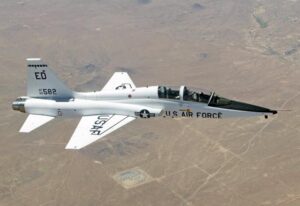 Northrop T-38 Talon
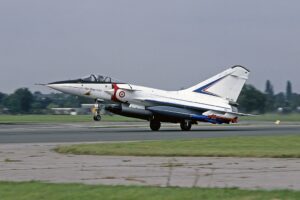 Dassault Mirage 4000
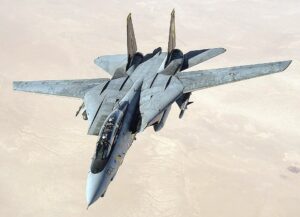 Grumman F-14 Tomcat
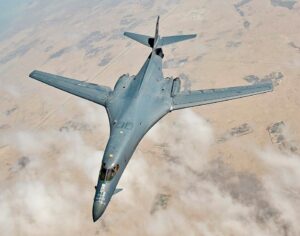 Rockwell B-1 Lancer
 Lockheed D-21